PR Jargon, Decoded: A Brand’s Guide to Speaking the Language of Public Relations
Date:
November 6, 2026
Author:
Priyadarshini Basu

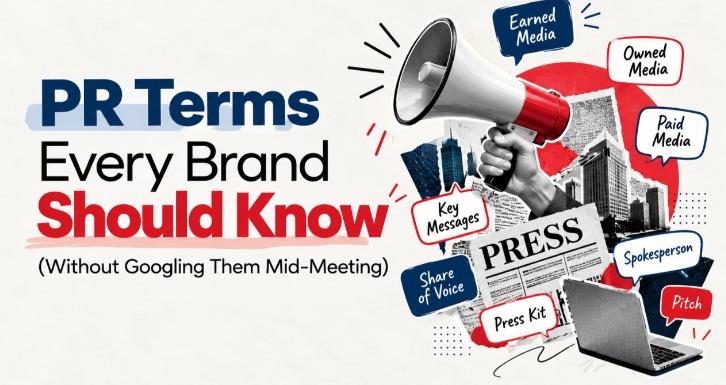



Ever sat in a meeting and heard “earned media,” “share of voice,” and “key messaging” thrown around like everyone was born knowing what they mean?
Don’t worry. You’re not alone.
PR has its own vocabulary. And if you’re a brand trying to build visibility, credibility and trust, understanding a few of these terms can make your next agency meeting a whole lot more interesting.
So, let’s ditch the jargon and decode the language of PR.
Imagine your brand gets featured in a leading publication because a journalist genuinely finds your story newsworthy.
That’s earned media.
You didn’t buy the space. You earned the attention.
Brand takeaway: You can pay for visibility, but credibility is built differently.
Your website, blog, newsletter and social media channels are your brand’s digital real estate.
You decide what goes live, when it goes live and how your story is told.
Brand takeaway: Don’t just rent attention. Build platforms where your audience can find you.
Sponsored posts, digital ads and paid placements help your message reach audiences beyond your existing community.
It’s like getting a VIP pass to visibility. But remember, visibility alone doesn’t guarantee trust.
Brand takeaway: Paid media gets you seen. Your content gives people a reason to care.
Imagine five brands competing for attention in the same category. How much of the conversation is about you?
That’s the idea behind share of voice.
It helps you understand how visible your brand is compared with competitors across relevant media or channels.
Brand takeaway: Being present is good. Being part of the conversation is better.
If someone asks five different people in your company what your brand stands for, will they all give the same answer?
Your key messages are the core ideas you want people to remember, repeated consistently across interviews, campaigns and communication channels.
Brand takeaway: Your brand can tell a thousand stories, but they should all sound like they belong to the same brand.
That short company description at the end of a press release? That’s your boilerplate.
It tells journalists who you are, what you do and why your organisation matters.
Think of it as your brand’s introduction at a networking event. Short, clear and memorable.
Brand takeaway: If your company description sounds like it could belong to any competitor, it’s time for a rewrite.

New Year resolutions for the Indian PR Professional
Shiv Shankar Devaraaj 7 years ago

Corporate Communications guidebook for companies to…
Shiv Shankar Devaraaj 6 years ago
The Changing PR Landscape
Shiv Shankar Devaraaj 7 years ago
You have exciting news ready to share, but journalists have been asked not to publish it until an agreed date and time.
That’s an embargo.
It gives media professionals time to prepare their coverage before the announcement goes public. It relies on clear agreement and trust.
Brand takeaway: Timing is part of the story. Just make sure everyone knows the rules.
Company profile, leadership bios, high-resolution images, product information and other relevant assets.
A press kit brings essential information together so journalists don’t have to chase your team for every detail.
Brand takeaway: Make it easy for the media to tell your story accurately.
When a journalist wants a comment, an expert opinion or a leadership perspective, who speaks on behalf of your organisation?
That’s your spokesperson.
It could be your founder, CEO or a subject-matter expert who can communicate clearly and confidently.
Brand takeaway: Your spokesperson doesn’t just represent your brand. They help shape how people perceive it.
A PR pitch is a tailored story proposal sent to a journalist.
The trick? It shouldn’t simply announce how wonderful your brand is. It should explain why the story matters to their audience.
Because “We have launched a new product” is an announcement.
But “Here’s how this product addresses a growing consumer problem” could be a story.
Brand takeaway: Stop asking, “How do we get coverage?” Start asking, “What makes our story worth covering?”
Understanding PR terminology is a good start. But the real value comes from understanding how these pieces work together.
Your owned channels build your narrative. Paid media can amplify it. Earned media can add independent credibility. Consistent key messages help connect the dots.
And when PR works alongside digital marketing, your brand story has more opportunities to travel, reach relevant audiences and create meaningful engagement.
Because the goal isn’t just to get your brand mentioned.
It’s to make your brand matter.
At K2 Communications, we believe communication works best when strategy, storytelling and visibility come together.
Over to you: Which PR term has confused you the most in a meeting? Or is there one you think every brand should understand?
Let’s decode it in the comments.
#K2Communications #PublicRelations #BrandCommunication #DigitalMarketing #PRStrategy