The Cockroach Protest in Delhi: A Masterclass in How Public Conversations Are Built Today.
Date:
November 6, 2026
Author:
Priyadarshini Basu




The recent ‘cockroach protest’ in Delhi has sparked debates across social media, editorial meetings and newsrooms. While opinions on the protest itself should remain divided or subjective, there is another conversation that deserves equal attention, which is about how narratives are created, amplified and sustained in today's communications scene.
Not because traditional media has become less relevant.
Not because digital media has become more powerful.
But because the boundaries between the two have disappeared.
The New Communications Ecosystem
There was a time when a story followed a predictable path. An event occurred, journalists reported it, audiences consumed it, and public opinion gradually evolved.
Today, the journey is far more dynamic.
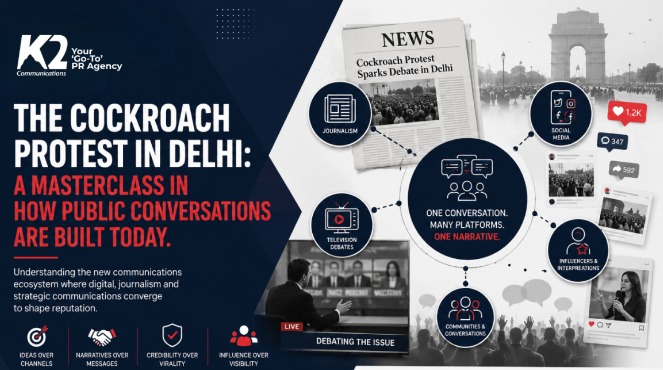
A visual moment captures attention on social platforms. Communities begin discussing it. Journalists investigate the issue, verify facts and provide context. Television debates amplify the discussion to millions. Influencers interpret it.
This isn't a competition between digital and traditional media.
It is an ecosystem where each strengthens the other.
Digital platforms accelerate discovery, and Journalism provides credibility.
Strategic communications brings coherence to the narrative.
The Shift Every Communicator Needs to acknowledge - The most successful campaigns today are designed around ideas too, not just channels.
The execution may vary across media relations, digital platforms, leadership visibility, stakeholder engagement or community conversations, but the narrative needs to remain consistent.
The role of communications has evolved from just message dissemination to narrative orchestration - And that is a far more strategic responsibility.
What This Means for Organizations
Whether you're a corporate brand, a government institution, a university or a startup, the communications question has changed.
It's no longer "How do we get coverage?"
Or even, "How do we trend?"

How social media and big data are changing the game of…
Sumit Jain 7 years ago

Corporate Communications guidebook for companies to…
Shiv Shankar Devaraaj 6 years ago
The Changing PR Landscape
Shiv Shankar Devaraaj 7 years ago
The more relevant question is: How do we build a narrative that can travel across multiple ecosystems without losing credibility?
That requires a very different communications mindset.
One that understands media cycles. One that understands internet culture. One that understands stakeholder behavior.
And perhaps most importantly, one that recognizes that communications is no longer a support function rather it is a strategic business function.
Beyond Visibility: Designing Influence
One of the biggest misconceptions in our industry is equating visibility with influence.
Visibility can be bought.
Virality can be accidental.
But trust is designed.
It is built when every touchpoint—earned media, digital platforms, leadership communication, employee advocacy, community engagement and stakeholder outreach—reinforces the same narrative.
The Agencies That Will Lead the Next Decade
The communications firms that create the greatest value for clients will not necessarily be those with the longest media lists or the largest social media teams.
They will be those that can connect culture with credibility.
Who understand that newsrooms, algorithms and human behavior now influence one another.
The future of public relations isn't about securing headlines.
It's about understanding how headlines, hashtags, human behavior and stakeholder trust converge to shape reputation.
And in an increasingly interconnected world, that may well become the defining capability of strategic communications specialists.
Disclaimer: This article examines the communications and narrative-building aspects of a public event. It does not endorse or comment on the protest or the viewpoints of any individual or organization.